Caramelized Onion and Gruyère Tart
A buttery short-crust tart filled with slow-cooked caramelized onions, Gruyère, and a firm, sliceable custard. Make-ahead friendly for dinner parties.
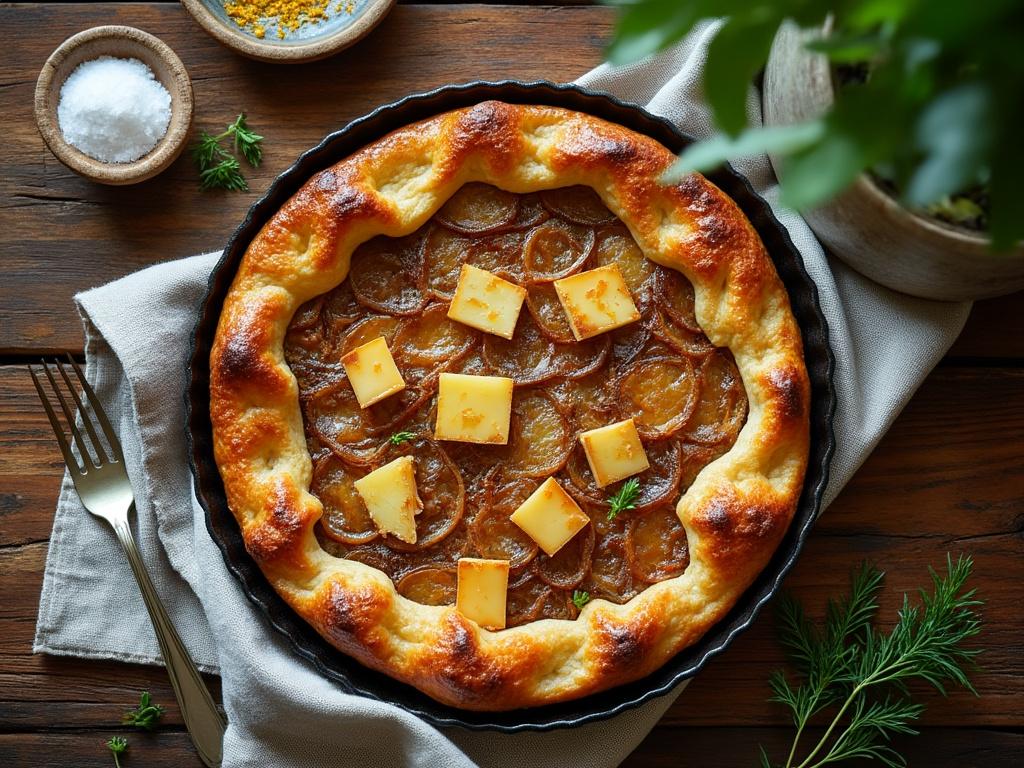
This tart is built around one long, slow process: three pounds of yellow onions cooked down to about a cup of dark, jammy mass. That reduction — 45-plus minutes of stirring over medium-low heat — is what separates this from a quiche that just happens to have onions in it. The Dijon mustard brushed over the blind-baked shell isn't optional; it seals the pastry against the wet filling and sharpens the savory base note in a way that you'll notice if you skip it.
The finished tart has a short, buttery crust, a custard that sets firm enough to slice cleanly, and a top layer of Gruyère that goes properly golden in the oven. It's a dinner party centerpiece that can be made almost entirely ahead — the dough and onions the day before, the final bake the afternoon of. Serve it at room temperature with a sharp green salad. If your custard puffs dramatically and then sinks in the center, the oven was too hot — 325°F is the ceiling.
Ingredients
- ▸ 1.5 cups all-purpose flour
- ▸ 0.5 tsp Diamond Crystal kosher salt
- ▸ 0.5 tsp granulated sugar
- ▸ 8 tbsp cold unsalted Kerrygold butter, cubed
- ▸ 3 tbsp ice water
- ▸ 3 lbs yellow onions, thinly sliced (about 6 medium onions)
- ▸ 3 tbsp unsalted butter
- ▸ 1 tbsp olive oil
- ▸ 0.5 tsp kosher salt
- ▸ 0.25 tsp freshly ground black pepper
- ▸ 0.25 cup dry white wine
- ▸ 1 tsp fresh thyme leaves
- ▸ 1 tsp Dijon mustard
- ▸ 3 large eggs
- ▸ 1 cup heavy cream
- ▸ 0.25 tsp freshly grated nutmeg
- ▸ 4 oz Gruyère cheese, coarsely grated
- ▸ 1 tbsp fresh thyme leaves, for finishing
🛒 Links may earn us a small commission at no cost to you.
Recommended Gear
🛒 We may earn a small commission at no extra cost to you. We only recommend gear we'd use ourselves.
Instructions
Make the Pastry
- 1. Combine the flour, salt, and sugar in a large bowl and whisk briefly to distribute. Add the cold cubed butter and work it into the flour with your fingertips or a pastry cutter until the mixture resembles coarse breadcrumbs with some flat, pea-sized pieces of butter still visible — about 2 minutes. Those butter pieces are what create flakiness, so don't overwork it.
- 2. Drizzle in the ice water 1 tablespoon at a time, tossing the dough with a fork after each addition until it just comes together when you squeeze a handful — it should hold its shape but not feel wet or sticky. Turn it out, press into a disk, wrap tightly in plastic, and refrigerate for at least 1 hour or overnight. The dough should feel cold and firm when you take it out.
- 3. Remove the dough from the refrigerator and let it sit for 5 minutes. On a lightly floured surface, roll it out to a 12-inch circle, about 1/8-inch thick, turning and flipping frequently to prevent sticking. Drape it over the tart pan and press it firmly into the fluted edges — you should hear a faint crinkle as the dough settles into the grooves. Trim any overhang flush with the rim. Prick the base all over with a fork, about 20 times, then freeze the shell for 20 minutes until firm.
- 4. Preheat the oven to 375°F. Line the chilled shell with parchment paper and fill with pie weights or dried beans to the brim. Bake on the middle rack for 20 minutes, until the visible edges are set and pale gold. Remove the weights and parchment, then bake another 8-10 minutes until the base is dry to the touch and just beginning to color — it should look matte, not shiny. Set aside. Reduce oven temperature to 325°F.
Caramelize the Onions
- 1. Heat the butter and olive oil together in a 12-inch skillet over medium heat until the butter melts and begins to foam, about 1 minute. Add all the sliced onions and the 0.5 tsp salt, tossing to coat. They'll heap up in the pan — that's fine. Cook, stirring every 4-5 minutes, for the first 20 minutes. The onions will soften and begin to wilt, releasing a significant amount of liquid that will then evaporate. At this stage they should smell savory and sharp, turning translucent.
- 2. Reduce the heat to medium-low. Continue cooking, stirring more frequently now — every 2-3 minutes — for another 25-30 minutes. Watch the bottom of the pan: a brown fond will develop and you should scrape it up each time you stir. The onions are ready when they're deep amber-brown, glossy, and reduced to about 1 cup of soft, jammy mass. They should smell sweet and rich with no raw sharpness. If they're darkening too fast in spots, lower the heat slightly and add a splash of water.
- 3. Pour in the white wine and stir vigorously to deglaze the pan — you'll hear a sharp sizzle and the fond will dissolve into the onions within 30 seconds. Stir in the thyme and black pepper. Cook for 1 more minute until the wine has mostly evaporated and the mixture smells bright and herby. Remove from heat and let cool for 10 minutes.
Build and Bake the Tart
- 1. Brush the base and sides of the blind-baked tart shell with Dijon mustard — use a pastry brush or the back of a spoon. This thin layer creates a moisture barrier that keeps the pastry crisp and adds a subtle savory depth to the base. Spread the cooled onion filling evenly over the mustard layer.
- 2. Whisk together the eggs, heavy cream, nutmeg, and a pinch of salt in a bowl until smooth and uniform — about 30 seconds of vigorous whisking. The custard should look pale yellow and slightly frothy. Pour it slowly and evenly over the onion filling, letting it settle into all the gaps. The filling and custard should come to just below the rim of the tart.
- 3. Scatter the grated Gruyère evenly over the top — it should cover the surface in a generous, slightly uneven layer. Finish with the fresh thyme leaves pressed gently into the cheese.
- 4. Carefully transfer the tart to the oven (a rimmed sheet pan underneath catches any drips) and bake at 325°F for 35-40 minutes. The tart is done when the edges are fully set and lightly puffed, the Gruyère on top is golden with a few darker spots, and the center has just a slight wobble when you gently shake the pan — like a just-set gelatin. It will firm completely as it cools.
- 5. Remove from the oven and cool on a wire rack for at least 20 minutes before unmolding. To unmold, set the tart pan on a tall, narrow can and let the outer ring drop away. Slide the tart off the base onto a cutting board or serving plate. Slice with a sharp knife, wiping the blade between cuts for clean edges.
Cook's Notes
- Slice the onions as uniformly thin as possible — a mandoline set to 3mm makes this faster and ensures they cook evenly. Inconsistent thickness means some pieces will burn while others are still underdone.
- The mustard layer is thin on purpose — about half a teaspoon spread over the entire base. You're creating a barrier, not a condiment layer. Too much mustard and it overwhelms the custard.
- Let the caramelized onions cool to room temperature before building the tart. Hot onions poured into the shell will start cooking the eggs in the custard before it even reaches the oven.
- Use a rimmed sheet pan under the tart when baking the custard. Custard occasionally seeps through small gaps in the tart pan base, and cleaning it off the oven floor is worse than the extra pan to wash.
- Wiping the knife between cuts isn't fussiness — the custard drags and tears if you pull a loaded blade through it.
Pro Tips
- → If the butter in your pastry is softening as you work it in — your hands are too warm or your kitchen is too hot. Stop, put the bowl in the freezer for 5 minutes, and continue. Warm butter means a mealy, dense crust instead of a flaky one.
- → The single most common failure mode with this tart is a soggy bottom. Two things prevent it: freezing the shell for 20 minutes before blind-baking (the cold fat holds its structure), and making sure the base is completely matte and dry before you add any filling. If it looks shiny after the second bake, give it 3 more minutes.
- → When rolling the pastry, rotate and flip it every few passes — not just rotate. If it sticks, you've either added too much water to the dough or your surface isn't floured enough. Lift the dough, re-flour under it, and keep moving. Don't add more flour to the top of the dough; it incorporates unevenly.
- → For the onion caramelization, the fond (the brown crust forming on the pan bottom) is flavor. Scrape it up completely every time you stir — if you leave it, it burns and turns bitter. If a spot looks like it's getting too dark before the onions are ready, deglaze with a tablespoon of water and scrape immediately.
- → The custard goes in slowly for a reason: pouring it too fast can dislodge the onion layer and create an uneven distribution. Pour it in a thin, steady stream starting from the center and let it find its own level.
- → When checking doneness, shake the pan with a deliberate, single side-to-side motion. A done custard moves as a single unit with a small wobble in the very center. If concentric ripples spread from the middle like a dropped stone in water, it needs more time.
What to Serve With This
A simple frisée or arugula salad dressed with a sharp Dijon vinaigrette cuts through the richness of the custard and cheese. The bitterness of the greens does the work that a squeeze of lemon can't quite do on its own. Avoid sweet dressings — they'll fight the caramelized onion sweetness already in the tart.
For wine, go with an Alsatian Pinot Gris or a dry Riesling from the Mosel. Both have enough acidity to balance the cream and Gruyère without overwhelming the delicate thyme. A white Burgundy or unoaked Chardonnay works well too. If you prefer red, a light Pinot Noir — something from Oregon or Burgundy, not a fruit-forward California bottle — is the move. The tannins stay out of the way.
For a non-alcoholic option, a sparkling water with a slice of lemon and a splash of white grape juice approximates the acidity you'd get from wine without going sweet.
On the bread side, a few slices of sourdough or a simple baguette are all you need. The crust on this tart is already substantial, so skip anything too dense or enriched — brioche would be redundant here.
Variations & Substitutions
This recipe is already vegetarian as written. To make it gluten-free, substitute a 1:1 gluten-free flour blend like Bob's Red Mill 1-to-1 for the all-purpose flour in the crust. The texture will be slightly more crumbly and less flaky — chill the dough longer (at least 2 hours) and handle it minimally. Use a tart pan with a removable bottom and don't attempt to free-hand transfer the dough; press it directly into the pan.
For a dairy-free version, use Miyoko's vegan butter in the crust (same weight) and substitute full-fat oat milk blended with 2 teaspoons of cornstarch for the heavy cream. The custard will be looser but will still set. Omit the Gruyère or use a dairy-free shredded Swiss-style cheese — Violife makes a reasonable one. The flavor won't be identical, but the tart will hold together.
Flavor variants worth trying: swap the Gruyère for aged Comté for a nuttier, slightly more complex finish. In fall, add a handful of thinly sliced roasted mushrooms (cremini or shiitake) layered over the onions before pouring the custard. A pinch of smoked paprika in the custard instead of nutmeg shifts the whole profile in a different direction. For scaling, this recipe fits a standard 9-inch tart pan. To make individual tarts in 4-inch pans, reduce bake time for the custard to 20-25 minutes and watch for the same wobble cue.
Frequently Asked Questions
Can I make this tart ahead of time? ▼
Yes — it's well-suited to advance prep. The pastry dough can be made up to 3 days ahead and refrigerated, or frozen for up to 2 months. The caramelized onions keep in the fridge for 3 days. You can also blind-bake the shell a day ahead and store it at room temperature, loosely covered.
How do I store leftovers? ▼
Wrap leftover slices in plastic wrap or store in an airtight container in the refrigerator for up to 3 days. The crust softens slightly after the first day but the flavor holds well. Bring slices to room temperature before serving or reheat briefly in the oven.
What's the best way to reheat this tart? ▼
A 300°F oven for 10-12 minutes is the best method — it revives the crust without overcooking the custard. Avoid the microwave; it makes the pastry rubbery and the custard weeps. A toaster oven on a low setting also works well for individual slices.
Can I freeze the baked tart? ▼
You can, though the custard texture degrades slightly after freezing and thawing. If you do freeze it, cool it completely first, then wrap the whole tart or individual slices tightly in plastic and then foil. Freeze for up to 6 weeks. Thaw overnight in the refrigerator and reheat in a 300°F oven.
What if I don't have a tart pan with a removable bottom? ▼
A 9-inch pie plate works in a pinch — you won't get the clean fluted edges, but the recipe functions the same way. Don't try to unmold it from a standard pie plate; just slice and serve directly from the dish. The bake times remain the same.
Can I use store-bought pie crust? ▼
A refrigerated all-butter pie crust like Trader Joe's or Dufour works, though it won't have quite the same snap or flavor as the homemade Kerrygold version. If you use store-bought, still blind-bake it and brush it with Dijon before filling — those steps matter regardless of the crust source.
My onions aren't browning — what's wrong? ▼
Most likely the heat is too low or the pan is too crowded for moisture to escape. Make sure you're using a full 12-inch skillet. If the onions are steaming rather than browning, increase the heat slightly and stir less frequently so they make contact with the pan. Patience matters more here than technique — 45 minutes is a realistic minimum.
Can I substitute another cheese for Gruyère? ▼
Comté is the closest substitute and actually has a slightly deeper, nuttier flavor. Emmental works but is milder. Fontina melts beautifully but is less sharp. Avoid fresh mozzarella — it releases too much water and will make the top of the custard wet.
How do I know when the custard is done baking? ▼
The edges should be set and lightly puffed, and the Gruyère on top should be golden with some darker spots. The center should have a small, uniform wobble when you shake the pan — not sloshing, just a gentle jiggle. If the whole surface moves as liquid, give it another 5 minutes.
Do I have to use dry white wine in the onions? ▼
The wine is primarily used to deglaze the fond, so the alcohol cooks off almost immediately and what remains is acidity. A dry vermouth works well as a substitute. If you need to avoid alcohol, use 2 tablespoons of low-sodium chicken or vegetable broth plus a teaspoon of white wine vinegar to approximate the same effect.
Enjoyed this recipe?
Daily Home Cookery is self-funded. If something you cooked here made dinner a little better, a coffee keeps the kitchen running.
☕ Buy me a coffeeYou Might Also Like
No-Knead Dutch Oven Bread
Crusty, chewy Dutch oven bread with just flour, salt, yeast, and water. Mix it the night before — no kneading, no fuss. Step-by-step with troubleshooting tips.
Brown Butter Chocolate Chip Cookies
Brown butter adds deep, nutty flavor to these chewy chocolate chip cookies. Chilled dough, flaky sea salt finish, and a 12-minute bake.
Charred Leek and Potato Galette with Gruyère and Thyme
A flaky free-form galette filled with caramelized leeks, thinly sliced potato, and nutty Gruyère — impressive enough for a dinner party, easy enough for Sunday.