Caramelized Leek and Goat Cheese Frittata
A golden, custardy frittata with deeply sweet caramelized leeks and tangy goat cheese. Ready in 45 minutes — perfect for brunch or meal prep.
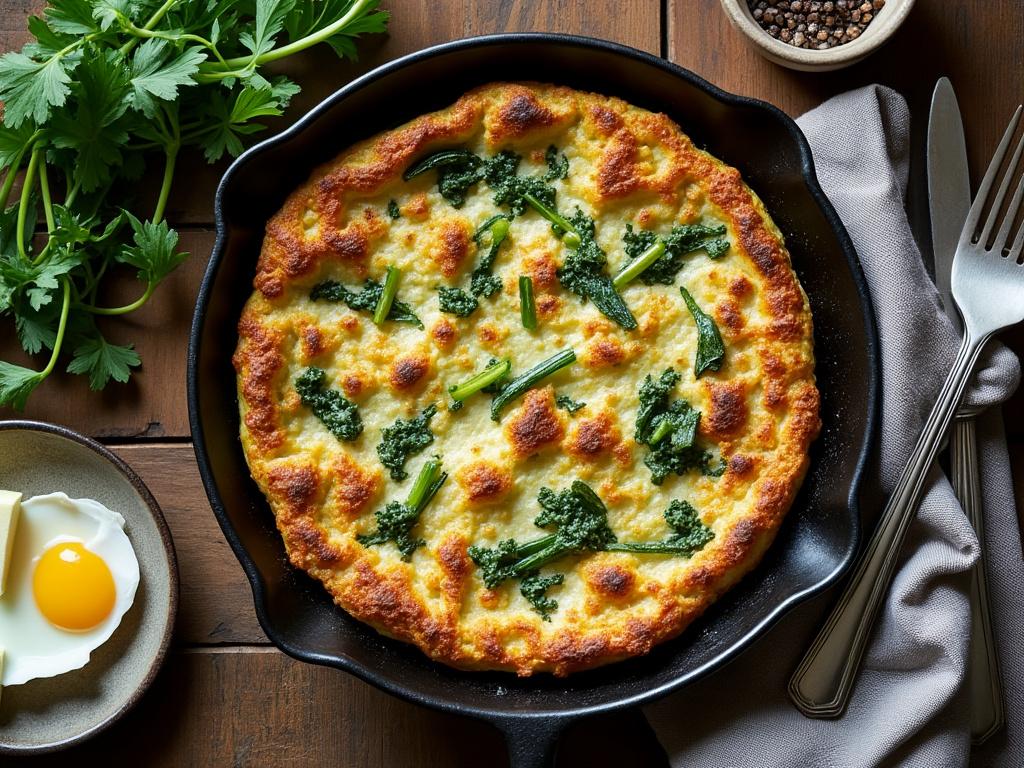
A frittata lives or dies by how you treat the eggs — rush them and you get rubbery, greasy wedges. This version solves that with a low-and-slow oven finish after a stovetop start, giving you a uniformly set, just-trembling center with no brown, overcooked bottom. The leeks do the heavy lifting here: cooked down for a full 15 minutes in butter until they collapse into silky, golden-edged ribbons, they bring a natural sweetness that punches well above the ingredient count. Creamy goat cheese melts into pockets throughout rather than sitting on top, so you get tang in every bite.
This is the kind of dish that works equally well for a weekend brunch with a salad, a light weeknight dinner, or meal-prep slices stored for the week. If your frittata puffs dramatically in the oven and then deflates, that's normal — it will settle into a flat, dense set as it cools. If the edges brown too fast on the stovetop before the center sets, your heat is too high; drop it to low and move to the oven sooner.
Ingredients
- ▸ 2 tbsp Kerrygold unsalted butter
- ▸ 2 large leeks, white and light green parts only, halved lengthwise and sliced into 1/4-inch half-moons (about 2 cups sliced)
- ▸ 1/2 tsp Diamond Crystal kosher salt, divided
- ▸ 1/4 tsp freshly ground black pepper, divided
- ▸ 6 large eggs
- ▸ 3 tbsp whole milk
- ▸ 1/4 tsp dried thyme
- ▸ 1/8 tsp red pepper flakes
- ▸ 3 oz fresh goat cheese, crumbled into 1/2-inch pieces
- ▸ 1 tbsp fresh chives, finely chopped
- ▸ 1 tsp extra-virgin olive oil
🛒 Links may earn us a small commission at no cost to you.
Recommended Gear
🛒 We may earn a small commission at no extra cost to you. We only recommend gear we'd use ourselves.
Instructions
Prep
- 1. Position an oven rack in the center and preheat to 325°F. Halve the leeks lengthwise, slice into 1/4-inch half-moons, and submerge in a bowl of cold water for 2 minutes — the grit will fall to the bottom. Lift them out with your hands (don't pour through a colander or you'll redeposit the sand) and spread on a clean towel to dry.
- 2. Crack 6 eggs into a medium bowl. Add 3 tbsp whole milk, 1/4 tsp kosher salt, 1/8 tsp black pepper, 1/4 tsp dried thyme, and 1/8 tsp red pepper flakes. Whisk vigorously for 30 full seconds until no streaks of white remain and the mixture looks slightly foamy — this aeration is what keeps the texture light.
Caramelize the Leeks
- 1. Set the 10-inch skillet over medium-low heat. Add 2 tbsp butter and 1 tsp olive oil. When the butter is fully melted and foaming, add the sliced leeks. Sprinkle with the remaining 1/4 tsp kosher salt and toss to coat. The leeks will look like an alarming pile at first — that's fine.
- 2. Cook the leeks, stirring every 2–3 minutes, for 13–15 minutes total. They're ready when they've reduced to roughly a third of their original volume, are golden at the edges, and smell sweet and slightly nutty — not sharp or raw. If they start sticking before they're golden, add 1–2 tbsp of water and scrape the bottom of the pan.
Build and Cook the Frittata
- 1. Spread the caramelized leeks in an even layer across the bottom of the skillet. Distribute two-thirds of the crumbled goat cheese (about 2 oz) over the leeks, scattering it evenly. The fat from the leeks should be sufficient, but if the pan looks dry, add 1/2 tsp additional butter and let it melt before proceeding.
- 2. Increase the heat slightly to medium. Pour the egg mixture over the leeks and cheese in one steady pour. Let the eggs sit undisturbed for 60 seconds — you'll see the edges begin to set and turn opaque, and you'll hear a very faint sizzle. Then, using a silicone spatula, gently drag the cooked edges toward the center 3–4 times, tilting the pan so uncooked egg runs to the edges. Do this for about 90 seconds total, then stop.
- 3. Scatter the remaining 1 oz of goat cheese over the surface. The eggs should look about 70% set — glossy and jiggly in the center, firm around the edges. Slide the skillet into the preheated 325°F oven.
- 4. Bake for 8–11 minutes. The frittata is done when the center has just a gentle wobble when you shake the pan — it should quiver like set Jell-O, not wave like liquid. The surface will look matte (not wet) and have very slight puffing around the edges. Do not overbake: pull it at the wobble stage.
Finish and Serve
- 1. Remove the skillet from the oven and let the frittata rest in the pan for 5 minutes — it will continue to set from residual heat and firm up enough to slice cleanly. Scatter the chopped fresh chives over the top. The goat cheese pockets will look slightly golden and the surface will have settled flat.
- 2. Run a flexible spatula around the edges and underneath the frittata to loosen it. Slice into 4 wedges directly in the pan. Serve warm or at room temperature — both are good, but warm is better.
Cook's Notes
- Wash the leeks after slicing, not before — grit hides between the layers, and slicing first exposes all of it. The cold-water soak method is faster and more thorough than rinsing under the tap.
- Don't skip the resting time after the oven. Five minutes of carryover cooking is what takes the center from 'wet' to 'just set' without overbaking the edges.
- If you don't have an oven-safe skillet, transfer the partially set egg mixture to a well-oiled 9-inch pie plate after the stovetop phase and bake as directed — increase time by 2–3 minutes.
- Leftover frittata is excellent cold, straight from the fridge. It firms up considerably overnight, which makes it easy to pack in slices for lunch.
- Leeks must be completely dry before they go into the hot butter, or they'll steam instead of sauté and take much longer to caramelize.
Pro Tips
- → The single biggest mistake in frittata-making is using high heat — it sets the bottom before the top has a chance to cook, giving you a leathery base. Medium-low on the stovetop, then a low 325°F oven, is not timid cooking; it's precision.
- → If the frittata sticks when you try to slice it, you almost certainly need more fat at the pan-coating stage. After the leeks are done, press a folded paper towel around the exposed rim of the pan and add a thin film of butter before the eggs go in — this is your insurance.
- → Whisking the eggs for a full 30 seconds (not 5 seconds) genuinely changes the texture. You're dissolving the albumen strands and incorporating air; the result is a frittata that's noticeably more tender and less dense.
- → If the goat cheese is very cold from the fridge, it won't distribute well and will stay in large clumps. Let it sit at room temperature for 15 minutes before crumbling — it will break apart into smaller, more even pieces that melt more uniformly.
- → A cast iron skillet retains heat better than nonstick, which means the bottom keeps cooking even after you pull it from the oven. If using cast iron, pull the frittata when the center still looks slightly underdone (5% wobblier than you want to serve it) — it will finish perfectly during the 5-minute rest.
- → If your frittata deflates dramatically after coming out of the oven and the center looks wet and sunken, you pulled it too early. Slide it back in for 3 minutes at 325°F — a frittata can go back in, unlike a soufflé.
What to Serve With This
A crisp, dry white wine cuts through the richness of the eggs and goat cheese without overwhelming the delicate leek flavor. Sancerre or a Mâcon-Villages Chardonnay both work well here — the mineral edge of the Sancerre especially echoes the tang of the cheese. If you want something lower-key, a cold glass of dry sparkling water with lemon does exactly the same palate-cleansing job.
For a proper brunch spread, serve the frittata alongside a simple arugula salad dressed with just lemon juice, good olive oil, and flaky salt. The peppery bitterness of arugula contrasts the sweetness of the leeks and keeps the plate from feeling heavy. A handful of shaved Parmigiano-Reggiano on top of the salad pulls the whole table together.
If you're leaning into a weeknight dinner context, a bowl of lentil soup or a thick slice of toasted sourdough with good butter turns this into a complete meal. The starch rounds out what is otherwise a protein-forward plate.
For non-alcoholic drinks, a lightly brewed green tea or a sparkling cucumber-mint water both work cleanly. Avoid anything sweet — orange juice or fruit-forward mocktails will clash with the savory, slightly sulfurous depth of the caramelized leeks.
Variations & Substitutions
For a dairy-free version, swap the goat cheese for 3 oz of firm silken tofu crumbled into similarly sized pieces, and use 2 tbsp of extra-virgin olive oil in place of the Kerrygold butter. The tofu won't have tang, so add 1 tsp of apple cider vinegar to the egg mixture before pouring. The result is lighter and less rich, but still holds together cleanly.
To make this gluten-free, no changes are needed — the recipe is already naturally gluten-free as written. If you're scaling up to serve 8, double all ingredients and use a 12-inch oven-safe skillet or a 9x13-inch baking dish. Add 5 minutes to the oven time and check doneness with a gentle shake: the center should wobble like set Jell-O, not slosh like liquid.
For a more substantial, vegetable-forward variation, add 1 cup of thinly sliced roasted red peppers (jarred and patted dry) or 1 cup of packed baby spinach wilted directly in the pan after the leeks are done. Both add color and bulk without changing the fundamental technique. Spinach needs 1–2 minutes in the pan to wilt completely before the eggs go in.
A smoked salmon version works especially well for a dinner-party brunch: lay 3 oz of cold-smoked salmon in thin strips over the frittata in the last 2 minutes of oven time rather than mixing it in. Heat will gently warm but not cook it further, preserving the silky texture.
Frequently Asked Questions
Can I make this frittata ahead of time? ▼
Yes — frittata holds well at room temperature for up to 2 hours, which makes it ideal for a brunch spread. For full make-ahead use, cool it completely, wrap the skillet tightly in plastic wrap, and refrigerate for up to 4 days. Reheat individual slices in a 300°F oven for 8–10 minutes, or in a skillet over low heat covered with a lid for 4–5 minutes.
Can I freeze frittata? ▼
Technically yes, but the texture suffers — egg proteins tighten significantly on freezing, making the frittata denser and slightly rubbery after thawing. If you must freeze it, wrap individual slices in plastic wrap, then foil, and freeze up to 1 month. Thaw overnight in the fridge and reheat gently at 300°F; do not microwave from frozen.
What size skillet do I need? ▼
A 10-inch oven-safe skillet is the target for 4 servings — 6 eggs in a 12-inch pan will spread too thin and dry out before setting. If you only have a 12-inch pan, add 2 more eggs and increase the goat cheese to 4 oz. The frittata will still work, but increase oven time by 3–4 minutes.
My frittata stuck to the pan. What went wrong? ▼
Two likely culprits: the pan wasn't hot enough when the eggs went in, or you didn't use enough fat. Make sure the butter is fully foamed and just beginning to subside before pouring in the eggs. A well-seasoned cast iron or a nonstick pan will release cleanly; stainless steel is the trickiest surface for eggs and needs more fat.
Can I use a different cheese? ▼
Absolutely. Feta (3 oz, crumbled) is the most direct swap — same crumbly texture, similar tang. Gruyère (2 oz, shredded) melts more completely and gives a nuttier, richer result. Avoid very wet cheeses like fresh mozzarella, which will release water into the eggs and make the center soggy.
How do I know when the frittata is fully cooked? ▼
Give the skillet a gentle shake — the center should quiver slightly like just-set Jell-O but not slosh or ripple in waves. The edges will look fully opaque and slightly pulled away from the pan. A knife inserted 1 inch from the center should come out clean, with no wet egg clinging to it.
Can I make this on the stovetop entirely, without using the oven? ▼
Yes, but it requires more attention. After pouring in the eggs, cover the skillet with a tight-fitting lid and cook over the lowest possible heat for 12–15 minutes. The trapped steam sets the top. Lift the lid every few minutes to check — if the edges are browning aggressively before the center sets, slide a folded dish towel under the lid to trap steam and diffuse heat.
How do I get the leeks sweet without burning them? ▼
Patience and medium-low heat. Leeks caramelize at a gentler pace than onions and will turn bitter and stringy if rushed on high heat. Keep the heat at medium-low, stir every 2–3 minutes, and add a splash of water (1–2 tbsp) if they start to stick before they're golden. The full 15 minutes is not optional if you want the sweetness to develop.
Can I add meat to this? ▼
Yes — 3 oz of cooked, crumbled bacon or diced pancetta added to the pan after the leeks are done works well. Cook the meat first and drain off most of the fat before adding the leeks, or the whole thing will be greasy. Pre-cooked Italian sausage (crumbled, about 2 oz) also works and leans the dish toward a heartier breakfast.
Enjoyed this recipe?
Daily Home Cookery is self-funded. If something you cooked here made dinner a little better, a coffee keeps the kitchen running.
☕ Buy me a coffeeYou Might Also Like
Fluffy Scrambled Eggs with Chives
Low-heat scrambled eggs made with butter, heavy cream, and fresh chives. Technique-driven recipe for soft, glossy curds every time.

Crispy Cabbage and Andouille Hash with Fried Eggs and Hot Honey
Smoky andouille, caramelized cabbage, and crispy potatoes topped with fried eggs and hot honey. A fast, savory skillet breakfast worth waking up for.
Overnight Oats with Berries
Thick, creamy overnight oats made with Greek yogurt, chia seeds, and mixed berries. 5 minutes of prep, 4 jars ready for the week.