Charred Leek and Potato Galette with Gruyère and Thyme
A flaky free-form galette filled with caramelized leeks, thinly sliced potato, and nutty Gruyère — impressive enough for a dinner party, easy enough for Sunday.
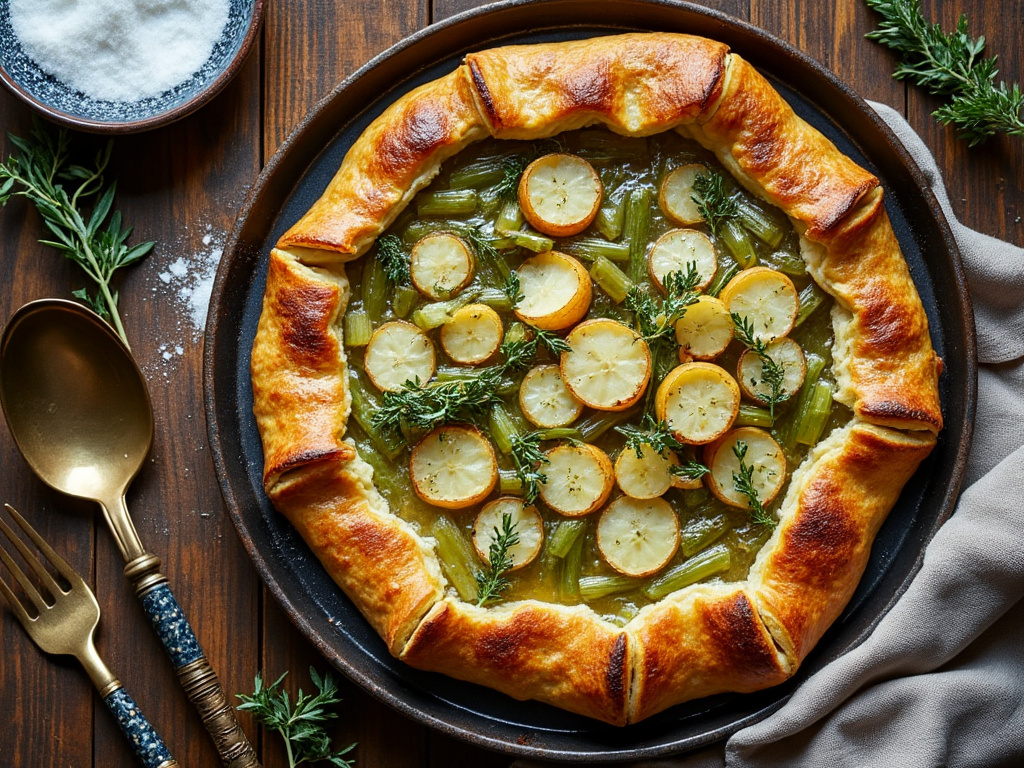
A galette is just a rustic tart — no tart pan, no blind baking, no drama. What makes this one work is the combination of two techniques most home cooks skip: charring the leeks in a dry skillet before they go into the filling, and par-cooking the potato slices so they finish tender inside the pastry without releasing too much steam. Both steps take 10 extra minutes and completely change the result. Expect a deeply savory filling with a slight sweetness from the leeks, earthy nuttiness from the Gruyère, and a shatteringly crisp butter crust underneath. This is weekend lunch territory, a light dinner with salad, or a dinner-party starter that looks far more technical than it is. The one failure mode to know upfront: if your potatoes are sliced too thick (over 1/8 inch), the center of the galette stays raw while the crust over-browns. Use a mandoline or a sharp knife and keep them thin.
Ingredients
- ▸ 1.5 cups all-purpose flour
- ▸ 0.5 tsp Diamond Crystal kosher salt
- ▸ 0.5 tsp granulated sugar
- ▸ 115 g unsalted Kerrygold butter, cold, cut into 1/2-inch cubes
- ▸ 4 tbsp ice water
- ▸ 1 large egg, beaten (for egg wash)
- ▸ 2 large leeks, white and light-green parts only, halved lengthwise and sliced into 1/2-inch half-moons
- ▸ 2 tbsp unsalted butter
- ▸ 1 tbsp olive oil
- ▸ 3 cloves garlic, minced
- ▸ 1 tsp fresh thyme leaves
- ▸ 0.25 tsp freshly ground black pepper
- ▸ 0.5 tsp Diamond Crystal kosher salt
- ▸ 0.25 tsp freshly grated nutmeg
- ▸ 2 tbsp crème fraîche
- ▸ 90 g Gruyère cheese, coarsely grated
- ▸ 2 medium Yukon Gold potatoes (about 400g total), peeled and sliced 1/8-inch thin
- ▸ 1 tsp olive oil (for potatoes)
- ▸ 0.25 tsp salt (for potatoes)
- ▸ 1 tbsp coarse sea salt flakes (for finishing)
- ▸ 1 tsp fresh thyme leaves (for finishing)
🛒 Links may earn us a small commission at no cost to you.
Recommended Gear
🛒 We may earn a small commission at no extra cost to you. We only recommend gear we'd use ourselves.
Instructions
Make the Pastry
- 1. Combine 1.5 cups all-purpose flour, 1/2 tsp kosher salt, and 1/2 tsp sugar in a large mixing bowl. Add the cold butter cubes and toss to coat. Using your fingertips or a pastry cutter, work the butter into the flour until the mixture resembles coarse breadcrumbs with some pea-sized butter chunks still visible — this takes about 2 minutes and those chunks are what create layers, so don't overwork it.
- 2. Drizzle in 3 tbsp of the ice water and use a fork to mix until the dough just begins to come together. Press a small piece between your fingers — if it holds, stop. If it crumbles, add the remaining 1 tbsp water. Turn the dough out, press it into a flat disc, wrap in plastic, and refrigerate for at least 30 minutes. The dough should feel cool and firm, not sticky.
Char the Leeks and Make the Filling
- 1. Heat a 12-inch skillet over high heat until it just begins to smoke — no oil yet. Add the leek slices in a single layer and press them flat against the pan. Leave them completely undisturbed for 2 minutes, until the undersides are deeply golden and slightly charred at the edges. You'll smell them go from raw to sweet and caramelized. Stir, then cook another 1 minute.
- 2. Reduce heat to medium. Add 2 tbsp butter and 1 tbsp olive oil to the charred leeks. Add the minced garlic and cook, stirring, for 1-2 minutes until the garlic is fragrant and pale gold — not brown. Add 1 tsp thyme, 1/4 tsp black pepper, 1/2 tsp salt, and 1/4 tsp nutmeg. Stir to combine, then remove from heat. Let the mixture cool for 5 minutes, then stir in the crème fraîche. The filling should look glossy and smell deeply savory-sweet.
Par-Cook the Potatoes
- 1. Bring a medium saucepan of well-salted water to a boil. Add the potato slices and cook for exactly 4 minutes — they should be just barely tender when pierced with a knife tip but not falling apart. Drain immediately and spread on a clean kitchen towel. Pat dry. Toss gently with 1 tsp olive oil and 1/4 tsp salt. The slices should look slightly translucent and feel pliable, not stiff.
Assemble
- 1. Preheat the oven to 400°F (205°C) with a rack in the lower third. Line a rimmed half sheet pan with parchment paper. On a lightly floured surface, roll the chilled dough into a rough 13-14 inch circle, about 1/8 inch thick. Transfer it to the parchment-lined pan — roll it loosely around the rolling pin and unroll it onto the pan. If it cracks at the edges, press the dough back together with your fingers.
- 2. Scatter 60g of the grated Gruyère over the dough, leaving a 2-inch border around the edge. Spread the leek filling evenly over the cheese in an even layer. Arrange the par-cooked potato slices on top in overlapping concentric circles, working from the outside in. Scatter the remaining 30g Gruyère over the potato slices.
- 3. Fold the bare border of dough up and over the edge of the filling, pleating it every 2 inches as you go. The pleats don't need to be neat — press them firmly so they hold. If the dough cracks while folding, let it rest 3 minutes at room temperature, then continue. Brush the folded crust generously with the beaten egg. It should look shiny and golden yellow.
Bake
- 1. Slide the pan into the lower third of the oven and bake at 400°F (205°C) for 40-45 minutes, until the crust is deep amber-brown on the bottom and edges, the cheese on top is bubbling and spotting golden, and the potatoes are completely tender when pierced with a knife tip. Rotate the pan 180° at the 25-minute mark for even browning. The galette is done when the crust sounds hollow if you tap the bottom lightly with a finger.
- 2. Remove from the oven and let rest on the pan for 10 minutes before cutting — the filling needs time to set slightly or it will slide. Scatter flaky sea salt and fresh thyme leaves over the top just before serving. Cut into 6 wedges with a sharp knife or pizza cutter.
Cook's Notes
- The charring step on the leeks is non-negotiable for depth of flavor — a pale, softened leek filling tastes flat by comparison. You want real color on those edges.
- Gruyère grated on the large holes of a box grater melts more evenly than finely grated. Pre-shredded cheese has anti-caking starch that makes it clump rather than melt smoothly — buy a block.
- If the crust edges are browning faster than the center is cooking through, tent a strip of foil loosely over just the crust edges and continue baking.
- Leftovers reheat best on a wire rack in a 375°F oven, not the microwave. The crust stays crisp rather than turning soft and steamy.
- This galette is best served the day it's made. The crust softens overnight in the fridge, though reheating on a rack mostly rescues it.
Pro Tips
- → The single biggest reason galette crusts turn out leathery instead of flaky is overworking the dough after adding water. Stop mixing the moment the dough barely holds together — visible dry bits are fine, they'll hydrate during the rest in the fridge.
- → If your filling is too wet (especially if your leeks were large and waterlogged), the base of the galette will be soggy. After cooking the leeks, spread them on a plate and let them cool for 10 minutes before mixing in the crème fraîche — the extra evaporation time matters.
- → Cold butter in the pastry is non-negotiable. If your kitchen is warm and the butter starts melting into the flour during mixing (you'll see the mixture look greasy instead of crumbly), put the entire bowl in the freezer for 10 minutes and start again.
- → The lower-third oven rack placement isn't arbitrary — it puts the base of the galette closest to the heat source, which is what crisps the bottom crust. Middle rack baking often results in a pale, slightly doughy base even when the top looks done.
- → If the galette tears when you try to transfer it to a serving board, don't panic — slide it straight from the parchment onto the board and serve it from there. The rustic presentation is part of the point; no one needs to know it was unplanned.
- → If the cheese browns too fast before the potato center is cooked through, your oven runs hot. Reduce to 375°F (190°C) after the first 20 minutes and add 5-8 minutes to the total bake time.
What to Serve With This
A crisp, unoaked white wine is the natural partner here. A Mâcon-Villages or Saint-Véran — both Burgundian Chardonnays — have the minerality and green-apple brightness to cut through the richness of the Gruyère and butter crust without overpowering the leeks. If you prefer something with more edge, an Alsatian Pinot Blanc works beautifully; it's dry, low in oak, and has a slight nuttiness that echoes the cheese. For a non-alcoholic option, try sparkling water with a squeeze of lemon and a few fresh thyme sprigs steeped in it — it sounds fussy but takes 30 seconds and cleanses the palate between bites.
On the side, a simple bitter green salad does the most work. Frisée or radicchio with a sharp Dijon vinaigrette cuts the richness of the pastry. Avoid anything creamy — the galette is already rich and doesn't need more fat on the plate.
If you're serving this as a starter, a cup of clear chicken or vegetable consommé alongside is understated and exactly right. The clean broth amplifies the savory depth of the leeks without competing with the crust. For a heartier meal, a soft-boiled egg on the side turns this into a complete plate — the runny yolk pressed into the pastry is extremely good.
Variations & Substitutions
For a vegetarian version, this recipe is already meat-free. To make it fully vegan, substitute the butter in the pastry with 115g of solid coconut oil (chilled hard) and replace the egg wash with 2 tbsp of oat milk brushed on just before baking. The crust will be slightly less flaky but still crisp. For the filling, omit the Gruyère and use 80g of a good vegan cashew cheese — Violife's Just Like Parmesan block, finely grated, holds up well here.
For a gluten-free version, use a 1:1 gluten-free flour blend (Bob's Red Mill 1-to-1 is reliable) in the pastry at the same weight. Add 1/2 tsp of xanthan gum if your blend doesn't already contain it. The dough will be more fragile — chill it for a full 45 minutes before rolling and roll it between two sheets of parchment rather than on a floured board.
Flavor variants worth trying: swap Gruyère for aged Comté or sharp white cheddar. Add 2 tsp of finely chopped fresh rosemary to the leek filling instead of thyme. In autumn, layer 4 thinly sliced rounds of raw beet underneath the potato for color and a slight earthiness. For scaling: this recipe doubles well — make two separate galettes rather than one large one, as a bigger galette is harder to transfer and tends to crack.
Frequently Asked Questions
Can I make the pastry dough ahead of time? ▼
Yes — the dough keeps in the refrigerator, wrapped tightly in plastic, for up to 3 days. It also freezes well for up to 2 months; thaw it overnight in the fridge before rolling. Cold dough is actually easier to work with, so making it a day ahead is genuinely useful.
Can I assemble the galette ahead and bake it later? ▼
You can assemble the galette up to 4 hours ahead, keep it on its parchment-lined baking sheet, and refrigerate it uncovered. Don't add the egg wash until right before it goes into the oven. Baking from cold is fine and may actually improve the crust's flakiness slightly.
How do I store and reheat leftovers? ▼
Store leftover slices in an airtight container in the fridge for up to 3 days. Reheat on a wire rack set over a baking sheet at 375°F (190°C) for 8-10 minutes — this keeps the crust crisp rather than steaming it soggy. Avoid the microwave; it turns the pastry chewy and limp.
Can I freeze the baked galette? ▼
Yes, but the crust loses some of its crispness after freezing. Wrap individual slices in plastic wrap, then foil, and freeze for up to 1 month. Reheat directly from frozen at 375°F (190°C) for 15-18 minutes on a rack. It's good but not quite as good as fresh — this one is better made ahead in the fridge than frozen.
What if I don't have a mandoline? Can I slice the potatoes by hand? ▼
Yes, but you need to be precise. Use a sharp chef's knife and aim for slices no thicker than 1/8 inch (3mm). If they vary too much in thickness, the thinner ones will over-soften and the thicker ones will stay starchy. Take your time — uneven potato is the most common reason this galette disappoints.
Can I use store-bought pie crust instead of homemade? ▼
You can, and it works. Use one sheet of Pillsbury refrigerated pie dough, unrolled onto parchment. The flavor won't be as rich — homemade all-butter pastry has a noticeably more complex taste — but the technique and timing stay the same. It's a reasonable shortcut on a weeknight.
Why do I need to par-cook the potatoes? Can I skip it? ▼
Skipping it is the most common mistake with potato galettes. Raw potato slices release steam as they bake, which makes the crust soggy from the inside and often leaves the potato undercooked. The 5-minute par-cook removes excess moisture and ensures the potato finishes tender at the same time the crust turns golden. Don't skip it.
Can I substitute another cheese for Gruyère? ▼
Aged Comté is the closest swap and works perfectly. Fontina melts more but has a milder flavor. Sharp white cheddar works but tastes more American-diner than French. Avoid fresh mozzarella — it releases too much water. Whatever you use, grate it yourself; pre-shredded cheese has anti-caking powder that prevents smooth melting.
My galette cracked when I folded the edges. How do I fix it? ▼
This usually means the dough was too cold and stiff when you started folding. Let the rolled dough sit at room temperature for 3-4 minutes before folding the edges over the filling. If it cracks anyway, press the crack together firmly with your fingertips and seal it with a little egg wash — it will hold during baking and the rustic look is part of the appeal.
What size should I roll the dough? ▼
Aim for a rough 13-14 inch circle, about 1/8 inch thick. It doesn't need to be perfectly round — irregular edges are fine and look intentional. If it's too thick, the base won't crisp through; too thin and it tears when you transfer it. A 1/8-inch thickness is the target throughout.
Enjoyed this recipe?
Daily Home Cookery is self-funded. If something you cooked here made dinner a little better, a coffee keeps the kitchen running.
☕ Buy me a coffeeYou Might Also Like
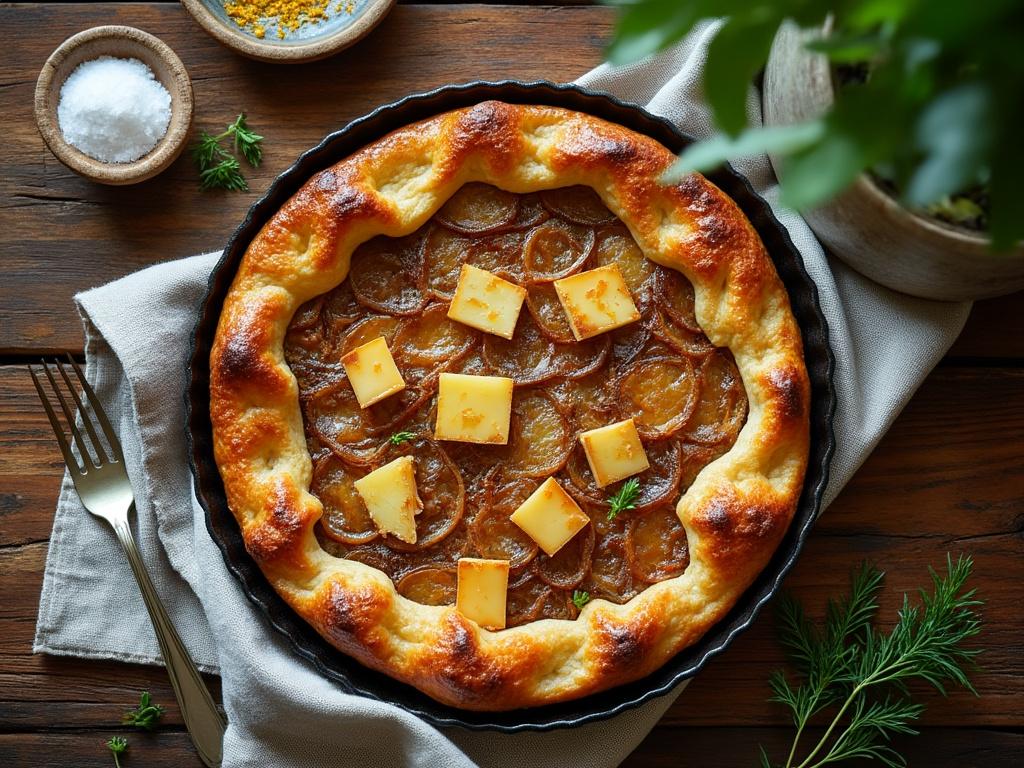
Caramelized Onion and Gruyère Tart
A buttery short-crust tart filled with slow-cooked caramelized onions, Gruyère, and a firm, sliceable custard. Make-ahead friendly for dinner parties.
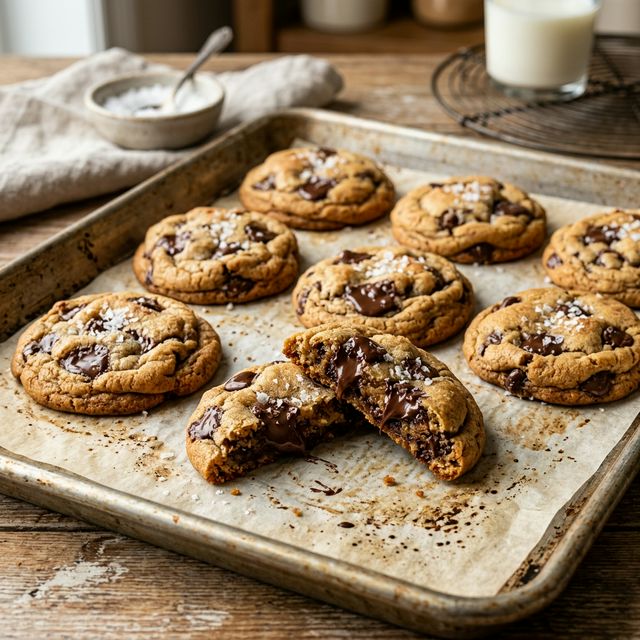
Brown Butter Chocolate Chip Cookies
Brown butter adds deep, nutty flavor to these chewy chocolate chip cookies. Chilled dough, flaky sea salt finish, and a 12-minute bake.
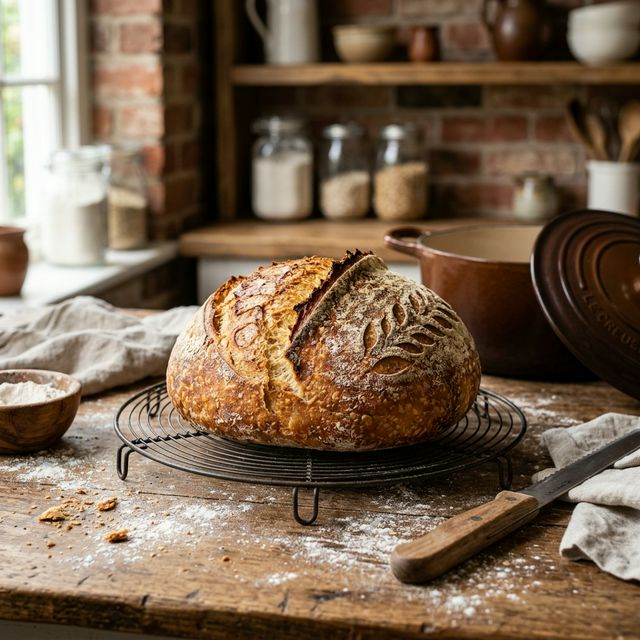
No-Knead Dutch Oven Bread
Crusty, chewy Dutch oven bread with just flour, salt, yeast, and water. Mix it the night before — no kneading, no fuss. Step-by-step with troubleshooting tips.