Smoked Paprika Butter Poached Lobster Tails with Saffron Corn Grits
Silky butter-poached lobster tails over saffron-scented stone-ground corn grits — a special-occasion dinner built in under an hour.
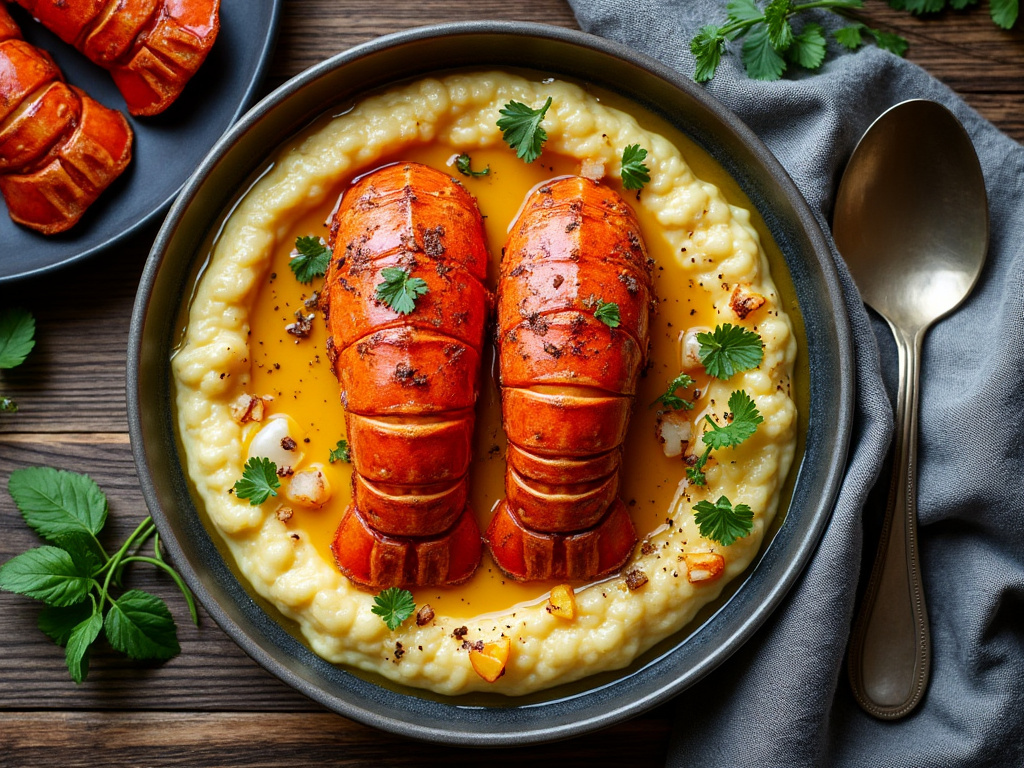
Butter poaching is the technique that turns an already-good ingredient into something genuinely unforgettable. Lobster tails submerged in a barely-simmering emulsified butter bath cook gently and evenly — no rubbery, overcooked meat, no chewy edges. The trick is temperature control: keep the butter between 160–180°F the entire time. Above 185°F, the emulsion breaks and you're left with greasy clarified butter instead of the glossy, rich poaching liquid that later gets spooned directly over the finished dish.
Smoked paprika bloomed in the butter adds a low, earthy smoke that doesn't compete with the lobster's sweetness — it underlines it. Below that, stone-ground corn grits cooked with saffron-steeped cream turn dense and savory with a faint floral note that ties the whole plate together. This is a Friday-night dinner-party dish you can realistically execute on a weeknight once you've made it once. If your butter starts to look oily and separated, whisk in a splash of cold water immediately to bring the emulsion back.
Ingredients
- ▸ 4 lobster tails (6–8 oz each), thawed if frozen, butterflied
- ▸ 2 cups unsalted Kerrygold butter, cut into 1-inch cubes
- ▸ 3 tbsp olive oil
- ▸ 2 tsp smoked paprika
- ▸ 1/2 tsp garlic powder
- ▸ 1/4 tsp cayenne pepper
- ▸ 1 tsp Diamond Crystal kosher salt, plus more to taste
- ▸ 1 tbsp fresh flat-leaf parsley, finely chopped
- ▸ 1 tbsp fresh chives, thinly sliced
- ▸ 1 tbsp fresh lemon juice
- ▸ 1 tsp lemon zest
- ▸ 1 cup Anson Mills stone-ground corn grits
- ▸ 3 cups whole milk
- ▸ 1 cup heavy cream
- ▸ 1/2 cup water
- ▸ 1/4 tsp saffron threads
- ▸ 2 tbsp unsalted butter
- ▸ 1/2 cup freshly grated Parmigiano-Reggiano
- ▸ 1/2 tsp white pepper
- ▸ 1 tsp kosher salt
🛒 Links may earn us a small commission at no cost to you.
Recommended Gear
🛒 We may earn a small commission at no extra cost to you. We only recommend gear we'd use ourselves.
Instructions
Prep
- 1. Butterfly the lobster tails: use kitchen shears to cut straight down the center of each hard top shell lengthwise, stopping just before the tail fin. Gently pull the shell halves apart and loosen the meat with your fingers, lifting it up and resting it on top of the shell — it should stay attached at the base. Pat each tail completely dry with paper towels. Season the exposed meat lightly with 1/4 tsp kosher salt total across all four tails.
- 2. In a small bowl, combine the saffron threads with 2 tbsp of warm water. Let steep for at least 10 minutes — the water will turn a deep amber-orange and smell faintly floral. This bloom extracts far more color and flavor than adding saffron directly to the pot.
Cook the Grits
- 1. Combine the whole milk, heavy cream, and 1/2 cup water in the 3-quart saucepan over medium heat. Add 1 tsp kosher salt and 1/2 tsp white pepper. When the liquid begins to steam and small bubbles form around the edges — about 5 minutes — pour in the saffron with its steeping water. Stir once to distribute.
- 2. Whisk in the stone-ground grits in a slow, steady stream to prevent clumping. Reduce heat to low and cook, stirring every 2–3 minutes with a wooden spoon, for 25–30 minutes until the grits are thick, creamy, and pull away from the sides of the pan as you stir — they should smell nutty and faintly sweet, the color a pale gold from the saffron. If they thicken too fast before they're fully cooked, add warm water, 1 tbsp at a time.
- 3. Remove from heat. Stir in 2 tbsp unsalted butter and 1/2 cup grated Parmigiano-Reggiano until both are fully melted and incorporated. Taste and adjust salt. Cover with a lid to keep warm — grits hold well off-heat for 15 minutes before needing a reheat splash.
Build the Poaching Butter
- 1. In the 2-quart saucepan over medium-low heat, combine 3 tbsp olive oil and 2 tsp smoked paprika. Cook, stirring, for 60–90 seconds until the paprika darkens slightly and smells smoky and toasted — it will sizzle softly. Don't walk away; paprika scorches fast.
- 2. Add the cubed Kerrygold butter two or three pieces at a time, whisking constantly as each addition melts. Continue adding butter while maintaining the heat low enough that the mixture steams but never simmers. Clip your thermometer to the pan side — hold the temperature between 160–180°F throughout. Add garlic powder and cayenne, whisking to incorporate. The finished poaching butter should look glossy and uniform, not oily or separated.
Poach the Lobster
- 1. Gently lower the butterflied lobster tails into the poaching butter, meat-side down. Spoon butter continuously over the tops of the tails using a large spoon. Poach for 6–9 minutes, maintaining 160–180°F, until the meat is fully opaque, springs back gently when pressed, and registers 140°F on an instant-read thermometer. The shells will turn bright red and the butter will smell sweet and smoky — that's your cue the lobster is nearly done.
- 2. Remove the tails from the butter and set aside briefly on a warm plate. Add lemon juice and lemon zest to the remaining poaching butter and whisk to combine. Taste for salt. This is your pan sauce — it should taste rich, slightly acidic, and deeply savory.
Assemble
- 1. Spoon a generous mound of saffron grits into the center of each warmed shallow bowl. Set one lobster tail on top, meat facing up. Spoon 2–3 tbsp of the smoked paprika butter sauce over each tail and into the bowl. Finish with a scatter of fresh parsley and chives. Serve immediately — grits skin over quickly once plated.
Cook's Notes
- Stone-ground grits take 25–30 minutes of patient stirring. Don't rush them over high heat — the outside cooks before the center hydrates and you'll get a gritty texture. Low and slow is the rule.
- Butterfly the lobster tails before starting the grits — prep is the one step you can't rush back to. Once the butter poaching starts, it moves fast.
- If your saffron is older than 6 months, double the quantity to 1/2 tsp — saffron loses potency quickly once a jar is opened.
- Warm your serving bowls in a 200°F oven for 10 minutes before plating. Cold bowls kill the grits texture within 60 seconds of plating.
- The poaching butter left in the pan is too good to waste — strain it through a fine-mesh strainer and refrigerate for up to 1 week. It's excellent melted over roasted vegetables or tossed with fresh pasta.
Pro Tips
- → If the butter emulsion breaks during poaching — it'll look greasy and separated rather than glossy — pull the pan off heat immediately and whisk in 1 tbsp cold water in a thin stream. The cold water re-emulsifies the fat. Reattach the thermometer and return to low heat only once it looks uniform again.
- → Lobster tails vary significantly in thickness by brand and origin — a 6-oz Maine tail cooks faster than a 8-oz warm-water tail of the same weight because of shell-to-meat ratios. Always use the thermometer, not just the timer.
- → Don't salt the poaching butter until after the lobster is removed. The salt concentrates as the butter sits and you'll have a better-calibrated sauce if you season at the end.
- → For the smoothest grits, keep a small pot of simmering water on the back burner as a reserve. If your grits seize up before they're fully hydrated, adding cold liquid causes an uneven texture — use only hot liquid to thin.
- → Room-temperature butter poaches more evenly than cold butter pulled straight from the fridge. Pull your Kerrygold out at least 20 minutes before starting — it'll melt into the emulsion faster and more consistently, keeping your temperature stable.
- → If you're serving this for a dinner party, the grits can be made 2 hours ahead and held over a pot of barely simmering water (double-boiler style) with a piece of parchment pressed against the surface to prevent skinning. Reheat with 1–2 tbsp cream per cup of grits just before plating.
What to Serve With This
A white Burgundy — specifically a village-level Mâcon-Villages or a Pouilly-Fuissé — is the right call here. The wine's lactic richness mirrors the butter poaching liquid while its mineral edge cuts through the fat. Avoid anything too oaky; a heavily wooded Chardonnay will clash with the saffron. If you want something more accessible, a good Chablis Premier Cru works beautifully for under $30.
For a non-alcoholic option, sparkling water with a long squeeze of Meyer lemon and a few drops of white balsamic keeps the palate clean between bites without competing with the saffron. Cold, unsweetened hibiscus tea also works — the tartness acts as an acid foil.
On the plate, a simple frisée salad dressed with just Champagne vinegar, a touch of Dijon, and walnut oil is the right side. Bitter frisée contrasts the richness of the grits and doesn't muddy the lobster's flavor the way a heavy salad would. Keep it undressed until the last minute so it stays crisp.
For bread, a crusty demi-baguette is more useful than decorative — you'll want something to scrape up the saffron-butter pan drippings. Warm it in a 350°F oven for 5 minutes so the crust has snap.
Variations & Substitutions
For a dairy-free version, replace all butter with a high-quality vegan butter such as Miyoko's European Style and substitute the heavy cream in the grits with full-fat coconut cream. The coconut cream will add a slight tropical note that actually pairs well with the saffron — lean into it by finishing with a few drops of lime juice. The poaching technique works identically with vegan butter as long as you maintain the same 160–180°F temperature range.
If lobster tails are out of budget or unavailable, large shell-on shrimp (16/20 count, about 1.25 lbs total) are a direct swap — reduce the poaching time to 4–5 minutes. Jumbo sea scallops also work; pat them completely dry before adding to the butter bath, and poach for just 3–4 minutes. Either option delivers the same saffron grits base with a different protein at a fraction of the cost.
For a spicier profile, add 1/4 tsp of cayenne and 1 tsp of ground chipotle to the smoked paprika bloom in the butter. This pushes the flavor toward a Cajun direction — in that case, swap saffron grits for stone-ground grits seasoned with roasted jalapeño and sharp white cheddar instead.
Doubling the recipe for 8 people is straightforward but requires two separate saucepans for the butter poaching stage — don't crowd more than 4 tails into a single pan or the temperature will drop too sharply when you add the lobster.
Frequently Asked Questions
Can I use frozen lobster tails? ▼
Yes — frozen lobster tails work well here. Thaw them overnight in the refrigerator on a rimmed plate, still in their packaging. Never thaw in warm water; it starts to cook the outer meat unevenly before the center is ready. Pat completely dry before butterflying.
How do I know when the lobster is done poaching? ▼
The meat turns fully opaque and pulls slightly away from the shell — it should feel firm but gently springy when pressed, not hard. An instant-read thermometer inserted into the thickest part should read 140°F. At 145°F it's still fine; above 150°F it becomes noticeably rubbery.
Can I make the grits ahead of time? ▼
Yes. Cook the grits up to 2 days ahead, cool completely, and refrigerate in an airtight container. Reheat over medium-low with a splash of cream or whole milk — start with 2 tbsp per cup of grits and stir constantly until smooth and hot. They'll thicken significantly in the fridge, so add liquid gradually.
What if I can't find stone-ground grits? ▼
Quick-cooking grits (like Quaker) will work but give a less toothsome, somewhat pastier result. If you go that route, reduce the liquid by about 1/4 cup and cut the cook time to 8–10 minutes. Avoid instant grits entirely — the texture is too smooth and they don't hold up under the lobster and sauce weight.
Can this be made for two people instead of four? ▼
Halve every ingredient exactly. Use a smaller saucepan — a 1.5-quart pan works for the grits. The poaching butter quantity halves too, which means you'll have slightly less pan sauce, so be intentional about spooning every drop. Cook time stays the same.
How do I butterfly lobster tails if I've never done it before? ▼
Use sharp kitchen shears to cut straight down the center of the hard top shell, stopping before the tail fin. Gently pull the shell halves apart and loosen the meat with your fingers, lifting it up and resting it on top of the shell — it stays attached at the base. This exposes the meat for even cooking and presentation.
Can I freeze leftovers? ▼
The grits freeze well — portion into an airtight container for up to 2 months. The lobster does not freeze well after poaching; the texture becomes watery and grainy on reheating. Plan to eat the lobster the day it's cooked. If you have leftover poached lobster meat, use it cold in a lobster roll the next day.
What's the best saffron to buy at a regular grocery store? ▼
Look for Spanish saffron labeled 'Superior' or 'Coupe' grade — Badia and Spice Islands both carry accessible options. Avoid saffron that looks orange or crumbly rather than deep red; it's old and has lost most of its potency. A 0.5g jar is enough for this recipe with some left over.
My butter sauce broke and looks greasy — can I fix it? ▼
Yes. Pull the pan off the heat immediately and whisk in 1 tbsp of cold water in a thin stream while whisking vigorously. The cold water re-emulsifies the fat. If it doesn't come back fully, a tiny squeeze of lemon juice (no more than 1/2 tsp) while whisking also helps. Prevention is better: keep heat under 180°F throughout.
Do I need to use a thermometer for the butter poaching? ▼
A probe thermometer or instant-read thermometer makes it significantly easier and removes the guesswork. That said, if you don't have one, look for the butter to have a faint shimmer on the surface with no visible bubbles breaking — lazy wisps of steam are okay, active simmering is too hot. Turn heat down to the absolute lowest setting your burner allows.
Enjoyed this recipe?
Daily Home Cookery is self-funded. If something you cooked here made dinner a little better, a coffee keeps the kitchen running.
☕ Buy me a coffeeYou Might Also Like
Crispy Pancetta and Leek Risotto with Lemon and Parmesan
A creamy, restaurant-worthy risotto with crispy pancetta, sweet leeks, and bright lemon. Ready in 50 minutes on the stovetop.

Charred Corn and Poblano Green Chile Enchiladas with Tomatillo Cream Sauce
Charred corn and poblano enchiladas smothered in a tangy tomatillo cream sauce. A vegetarian weeknight dinner that delivers real depth.

Tamarind-Glazed Pork Ribs with Coconut Rice and Quick-Pickled Mango
Sticky, lacquered pork ribs braised low and slow in tamarind glaze, served with coconut rice and bright pickled mango. Weekend dinner worth making.